
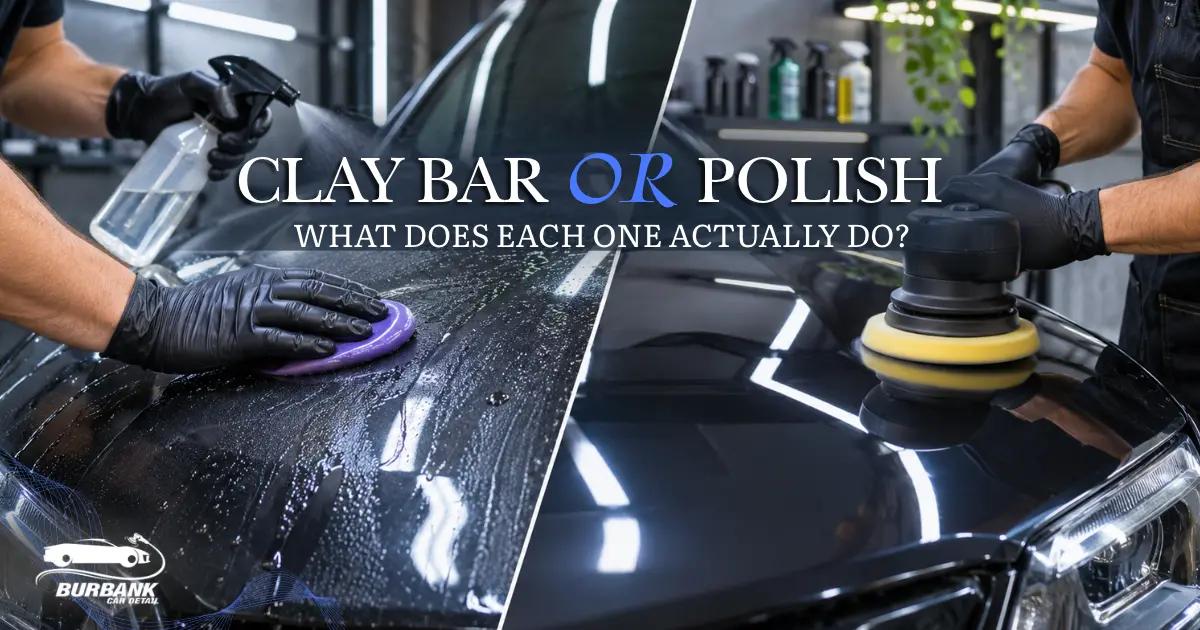
When comparing clay bar vs polish, the difference comes down to what problem you are trying to solve. A clay bar removes contaminants bonded to the surface of the paint. Polish, when used as a corrective abrasive product, refines the painted surface to improve defects such as light swirl marks, haze, and some shallow scratches. A simple way to think about it is this: If your freshly washed paint feels rough, contamination may be the problem. If the paint looks scratched, swirled, or hazy, polishing may be more appropriate. And sometimes a vehicle needs both. That does not mean every detail should automatically include claying and polishing. The right treatment depends on the paint's condition and the result you want.
What Does a Clay Bar Do?
A clay bar is primarily a paint decontamination tool. Normal washing can remove loose dirt, dust, and road grime, but some contaminants bond to the surface strongly enough that shampoo and water will not remove them. Meguiar's describes detailing clay as a way to remove contaminants such as tree sap mist, paint overspray, and industrial fallout from automotive paint. The result is a smoother surface that is better prepared for additional detailing steps such as polishing or waxing. That explains what a clay bar does better than thinking of it as another type of polish. Clay works on material sitting on top of the paint. It is especially useful when a vehicle has been washed but the surface still feels slightly gritty or rough when inspected carefully. Cars parked outside, vehicles exposed to industrial areas, and paint that regularly encounters tree sap or airborne contamination may be more likely to benefit from a clay bar treatment.
Does a Clay Bar Remove Scratches?
No not in the way polishing or paint correction does. A clay bar is designed to remove bonded contamination rather than level paint defects. Meguiar's specifically distinguishes rough paint that may need clay from finishes with swirls, oxidation, or stains that may require corrective products. So if you are asking does clay bar remove scratches, the practical answer is no. The scratch may appear slightly different once contamination around it is removed and the paint is clean, but the clay itself is not correcting the damaged clear coat. Improper claying can also introduce marring if the surface or clay is contaminated or insufficiently lubricated, which is another reason the process should not be treated casually.
How Often Should You Clay Bar Your Car?
There is no universal schedule. The better question is: Does the paint actually have bonded contamination? A car stored outdoors near trees, construction, rail lines, industrial fallout, or heavy traffic may need decontamination sooner than a vehicle stored indoors and washed regularly. After washing, inspect the finish. If the paint still feels rough, a clay treatment may be appropriate. If it already feels smooth and looks clean, there may be no reason to clay simply because a certain number of months has passed. That is why how often should you clay bar your car should be answered by paint condition rather than a calendar.
What Does Polishing Do to a Car?
Polishing addresses a different problem. In this article, car polish means an abrasive product intended to refine painted surfaces and correct certain defects. 3M's machine polish products are designed to remove compound swirl marks and minor surface defects while improving gloss and finish quality. Some of its finishing polishes are also intended to refine fine scratches, swirls, and everyday surface imperfections. That means polishing works by refining a very small amount of the painted surface or clear coat. This is fundamentally different from clay. Clay removes contamination attached to the surface. Polish works on the surface itself.
So what does polishing do to a car?
It can improve:
-
Light swirl marks
-
Haze
-
Fine scratches
-
Minor surface defects
-
Finish clarity and gloss
It does not automatically remove every scratch.
A scratch that extends too deeply into or through the clear coat may remain visible even after polishing. More aggressive correction may also remove more clear coat, which is why defect depth and paint condition matter.
Dark-colored vehicles can make swirl marks and polishing defects particularly visible. Our guide to Detailing a Black Car: The Best Car Polish Against Scratches explains why finish quality becomes especially noticeable on darker paint. Polishing should also not be confused with protection. Polish corrects or refines the finish. Wax, sealant, or coating is used afterward when suitable protection is needed.
Clay Bar vs. Polish vs. Compound: Pros and Cons
The clay bar vs polishing pros and cons become easier to understand when compound is added to the comparison. Compound and polish are both correction products, but compound is generally more aggressive. 3M describes its rubbing compound as a pre-polishing product designed to remove more significant correctable defects and sand scratches before a polishing stage.
|
Comparison |
Clay bar |
Polish |
Compound |
|
Main purpose |
Removes bonded surface contamination |
Refines the finish and improves light defects |
Addresses more pronounced correctable defects |
|
What it targets |
Overspray, fallout, sap mist, bonded contamination |
Light swirls, haze, fine scratches |
Heavier scratches and defects within correction limits |
|
Abrasive action |
Used for decontamination rather than intentional paint leveling |
Controlled abrasive refinement |
Generally cuts more aggressively than finishing polish |
|
Main benefit |
Creates a smoother, cleaner surface |
Improves clarity and gloss while correcting minor defects |
Provides greater correction when polish alone is insufficient |
|
Main limitation |
Does not correct scratches or swirls |
Cannot safely remove every defect |
Removes more material and requires careful assessment |
|
Typical next step |
Inspect, polish if needed, then protect |
Apply suitable protection |
Refine with polish if needed, then protect |
The main lesson is that the strongest treatment is not automatically the best treatment. If contamination is the problem, compound is unnecessary. If only light swirls need refinement, aggressive compounding may remove more clear coat than needed. And when comparing clay bar vs compound, remember that they are not competing versions of the same process. One decontaminates; the other corrects paint defects.
Should You Clay Bar Before Polishing?
If bonded contamination is present, it generally makes sense to remove it before corrective polishing. Meguiar's describes its professional detailing clay specifically as a preparation step that can help compounds, polishes, and waxes perform properly.
A practical sequence is:
Wash - inspect - decontaminate if needed - polish if needed to protect. The phrase if needed matters twice. You do not necessarily need clay before every polishing job. A well-maintained vehicle whose paint is already smooth and free of bonded contaminants may not need that step. But polishing heavily contaminated paint can interfere with the correction process because the surface has not been properly prepared. So when asking should you clay the bar before polishing, inspect the surface first. If contamination is present, clay or another appropriate decontamination method can prepare the paint before correction.
Do You Always Need to Polish After a Clay Bar?
No. This is another common misconception in the clay bar vs polishing discussion. If the only problem was bonded contamination and the paint looks good once it is removed, polishing may not be necessary. For example, imagine a relatively new vehicle that has spent months parked outdoors. After washing, the finish feels rough because of environmental fallout, but there are few visible swirls or scratches. Clay may solve the actual problem. On another vehicle, claying may reveal existing haze, swirl marks, or scratches that were harder to assess before decontamination. Polishing may then make sense. Occasionally, claying itself can leave light marring, depending on paint softness, contamination, technique, and product condition. In that case, a refining polish may be useful. So if you are wondering do you polish after clay bar treatment, the answer is: inspect first.
Do You Need to Wax Your Car After Claying?
Once paint preparation is finished, some form of appropriate protection is usually worth considering. Wax is one option. Depending on the vehicle and the detailing plan, owners may instead use a synthetic sealant or coating. Each type of protection has its own preparation requirements.Claying should not automatically be described as removing every trace of an existing wax or coating. How much protection remains depends on the product, contamination, and decontamination process. The more useful question is what is the next step after clay bar treatment? Inspect the finish first. If correction is needed, polish before applying your final protection. If the paint already looks good, move to the protection step appropriate for that vehicle. Our guide on How to Protect Your Car From Swirl Marks covers ongoing care after the paint has been cleaned and corrected.
Which Treatment Does Your Car Actually Need?
The easiest way to choose between clay, polish, and compound is to identify the problem before choosing the product.
The paint feels rough after washing but looks good
Bonded contamination may be present. A clay treatment or another suitable decontamination process may be enough.
The paint feels smooth but looks swirled or hazy
Contamination may not be the main issue. Polishing may be more appropriate because the visible problem is within the finish rather than sitting on top of it.
The paint feels rough and also has visible defects
The vehicle may need both steps. Decontamination prepares the surface first. Correction can then address appropriate swirls, haze, or shallow defects.
The paint has deep scratches, peeling, or failing clear coat
Neither clay nor ordinary polishing should be expected to fix serious paint failure. 3M's scratch-removal guidance illustrates an important limitation of correction: abrasive scratch removal works by refining clear coat around defects, and scratches that extend too deeply cannot simply be polished away safely. If you are unsure about scratch depth, see Can Scratches Be Removed by Car Detailing?.Peeling paint, failing clear coat, or broader surface damage may require a different level of repair. Our guide on When Do You Need a Car Paint Restoration? explains when a more complete assessment may be appropriate.
Clay Bar vs. Paint Correction
Clay bar vs paint correction is another useful distinction.Claying removes material bonded to the paint. Paint correction intentionally refines the painted surface through polishing and, when appropriate, compounding. Because correction removes some clear coat, it should not be performed repeatedly just because a calendar says it is time. Assess the paint first.
Is Clay Bar Treatment Worth It?
A clay bar treatment is worth it when bonded contamination is actually interfering with the finish. If the vehicle feels rough after a proper wash, clay can create a noticeably smoother surface and prepare the paint for further detailing. If the paint is already clean and smooth, claying may add work without solving a real problem. The same principle applies to the common question do I need compound or just polish? Use the least aggressive correction method that appropriately addresses the defect. More cutting power is not automatically better. The difference between clay bar vs polish becomes much simpler once you stop treating them as interchangeable detailing products. If the paint feels rough, bonded contamination may be sitting on the surface, and clay may be appropriate. If the paint looks swirled, scratched, or hazy, polishing may help refine correctable defects. If those defects are more pronounced, compound may be considered but only after assessing what the paint can safely tolerate. And sometimes the right answer is to do less.
A vehicle with contamination but good paint may only need decontamination. A smooth vehicle with light swirls may need polishing without claying. Deep scratches or failing clear coat may need repair rather than repeated correction. The best detailing treatment starts with the paint itself: inspect what you have, identify the actual problem, and choose the process that addresses it without doing more work than necessary.
 /
 /